True Costs of Vehicle Ownership in New York
Personal Finance, Vehicle Ownership, New York Drivers
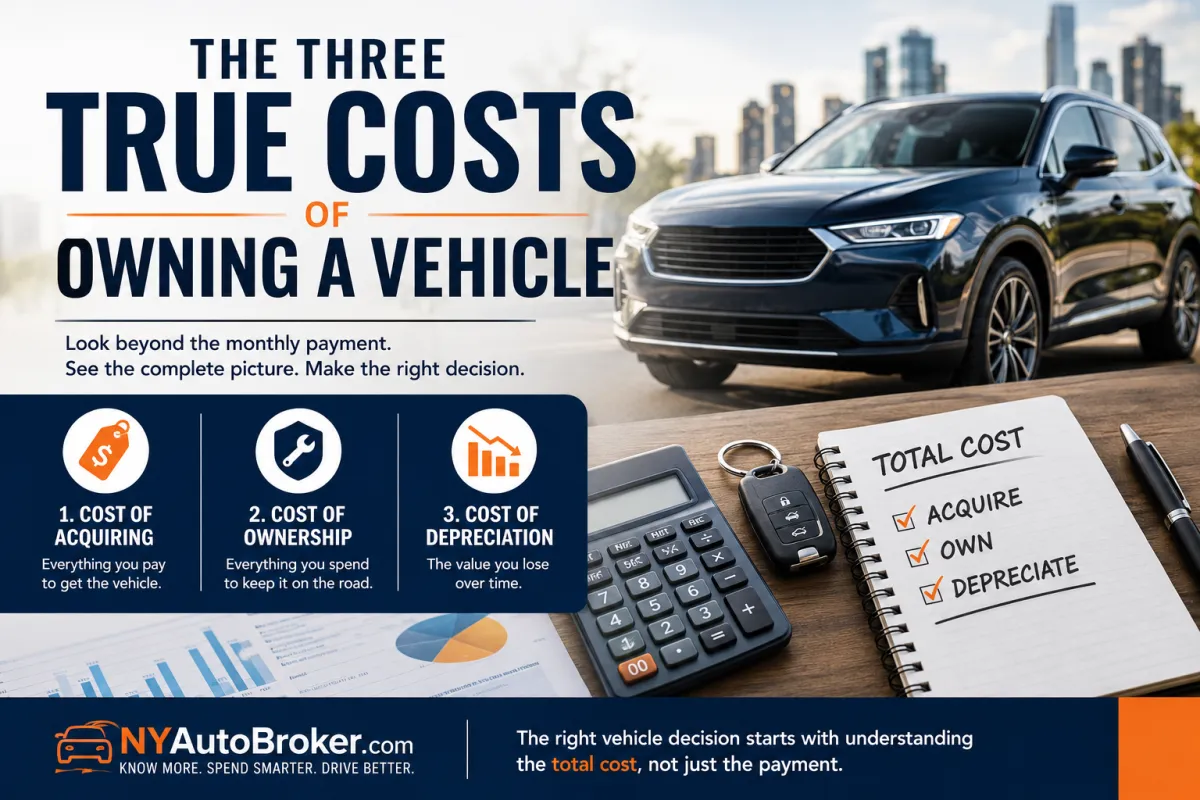
The Three True Costs of Owning a Vehicle
For New York drivers, a vehicle can be a necessity, a convenience, or both. But whether you park in a Queens driveway, a Brooklyn garage, or a Manhattan lot, every vehicle carries three major financial costs that go far beyond the monthly payment. Understanding these costs can help you decide whether to keep your current vehicle, replace it, or consider a different ownership path altogether.
1. The First True Cost: Acquiring the Vehicle
When most people think about what a car “costs,” they think about the sticker price or the monthly payment. In reality, the cost of acquiring a vehicle is a bundle of different expenses that show up on day one and throughout the life of the loan or lease. For New Yorkers, where taxes, fees, and insurance can be higher than the national average, it’s especially important to see the full picture.
1.1 Purchase Price and Taxes
The starting point is the negotiated price of the vehicle. To that, New York buyers must add:
State and local sales tax – often thousands of dollars on a new vehicle in the New York metro area.
Title and registration fees – to legally put the vehicle on the road in New York State.
1.2 Interest, Loan Term, and Down Payment
If you finance, the interest rate and loan term have a major impact on total cost. A longer term (72 or 84 months) can create a comfortable payment, but it usually means you pay far more in interest and stay in the loan longer than the vehicle’s “sweet spot” of reliability and warranty coverage.
Your down payment also matters. A higher down payment reduces both the payment and the interest you pay over time. A very low down payment may feel easier up front, but it can put you at higher risk of negative equity if the vehicle depreciates faster than you pay down the loan balance.
1.3 Fees, Warranties, and Accessories
Many New York buyers see additional items rolled into their financing:
Dealer fees and documentation fees.
Extended warranties or service contracts – which can be valuable, but still add to the acquisition cost.
Accessories like remote starters (popular in New York winters), roof racks, or upgraded wheels.
Each of these increases the amount you are financing and, by extension, the interest you pay over time. The true acquisition cost is the sum of the price, taxes, fees, add-ons, and interest over the full term of the loan or lease.
1.4 Negative Equity Rolled Into a New Loan
Many New Yorkers trade in vehicles while they still owe more than the car is worth. This is called negative equity. When that shortfall is rolled into a new loan, the new vehicle’s acquisition cost quietly increases, even if the payment looks similar. This can trap drivers in a cycle of always being “upside down” on their vehicles.
2. The Second True Cost: Owning and Operating the Vehicle
Once you drive off the lot, the second category of expenses begins: the cost of actually using the vehicle in everyday New York life. These costs can easily exceed the payment over the years, especially for higher-mileage drivers or those commuting into the city regularly.
2.1 Fuel or Electricity in a New York Commute
Gas prices in the New York metro area are often higher than the national average, and stop-and-go traffic on the BQE, LIE, or West Side Highway can drag down fuel economy. For gas vehicles, your annual fuel cost depends on:
Miles driven each year (including weekend trips upstate or to Long Island).
The vehicle’s real-world miles per gallon in New York traffic.
Local gas prices in your neighborhood or along your commute.
For electric vehicles, substitute electricity cost at home and at public chargers, plus any parking premiums for EV charging in city garages.
2.2 Insurance, Parking, and Tolls
New York insurance rates can be significantly higher than in rural areas due to traffic density, theft risk, and repair costs. Your vehicle choice affects your premium: performance cars, luxury models, and vehicles with expensive parts usually cost more to insure than modest sedans or compact SUVs.
Many city drivers also face monthly parking costs in garages or lots, which can rival a car payment in parts of Manhattan and Brooklyn. Add in tolls for bridges, tunnels, and upcoming congestion pricing, and the operating cost of a vehicle in New York can be substantial even before you consider maintenance.
2.3 Maintenance, Repairs, and Wear Items
Every vehicle needs routine care. Over several years, you can expect to pay for:
Oil changes and filters (or scheduled services for hybrids and EVs).
Tires – city potholes, curbs, and winter weather can shorten tire life.
Brakes – frequent stops in traffic and on bridges wear pads and rotors faster.
New York State inspections and registration renewals.
As the vehicle ages, bigger-ticket components can come into play: the engine, transmission, suspension, electrical system, emissions equipment, or a hybrid battery. Even a single major repair can equal several months of payments on a newer vehicle, which is why many drivers start to question whether to keep or replace an older car when repair estimates begin to climb.
3. The Third True Cost: Depreciation
Depreciation is the silent cost of vehicle ownership: the difference between what your vehicle is worth today and what it will be worth in the future. You don’t write a check for depreciation every month, but it directly affects your equity, your trade-in value, and what it costs to move into your next vehicle.
3.1 What Drives Depreciation?
Several factors determine how quickly your vehicle loses value:
Age and mileage – a five-year-old vehicle with 90,000 New York miles will usually be worth less than one with 40,000 miles.
Condition and accident history – body damage, interior wear, or prior accidents reported on Carfax can reduce market value.
Market demand – popular SUVs and fuel-efficient models may hold value better than slow-selling vehicles, especially when gas prices are high in New York.
Manufacturer incentives and redesigns – big rebates on new models or a full redesign can push down the value of older versions.
Technology changes – advanced safety features, connectivity, and EV technology can make older vehicles feel dated more quickly.
Remaining warranty coverage – vehicles still under factory warranty often command higher resale values.
3.2 Depreciation as a Real Cost
Imagine you buy a vehicle for $40,000 and sell it five years later for $18,000. You have effectively paid $22,000 in depreciation, before counting fuel, insurance, or repairs. For many New York families, depreciation is the single largest cost of vehicle ownership over time, even if it’s not as visible as the monthly payment or the gas pump.

Side-by-side cost comparisons often reveal how much depreciation truly adds up.
4. Why Monthly Payment Alone Can Be Misleading
It’s natural to focus on “What will my payment be?” However, the payment is only one piece of the puzzle. Two vehicles with similar or even identical payments can have very different total costs once you add fuel, maintenance, insurance, and depreciation.
4.1 A Simple New York–Style Comparison
Consider two hypothetical vehicles driven in the New York area for five years:
Vehicle A: Larger SUV, 7-year loan, $450/month payment, 18 MPG in city traffic.
Vehicle B: Fuel-efficient compact SUV, 5-year loan, $480/month payment, 30 MPG in city traffic.
On payment alone, Vehicle A looks cheaper: $450 vs. $480. But let’s add realistic New York–area costs over five years:
Fuel – If you drive 12,000 miles per year at $3.75 per gallon:
Vehicle A (18 MPG): roughly $2,500 per year, or $12,500 over five years.
Vehicle B (30 MPG): roughly $1,500 per year, or $7,500 over five years.
Difference: about $5,000 more in fuel for Vehicle A.Repairs and maintenance – The larger SUV may have higher tire, brake, and repair costs, especially after the standard warranty expires. Even a modest $300 per year difference adds another $1,500 over five years.
Depreciation – If the larger SUV depreciates faster, it may be worth several thousand dollars less than the compact SUV at the end of five years.
When you add these factors, the vehicle with the higher monthly payment (Vehicle B) can easily become the less expensive vehicle to own over the same time period. This is why focusing only on the payment can lead to decisions that cost more in the long run, especially in a high-cost driving environment like New York.
5. Understanding Vehicle Equity: Positive vs. Negative
Vehicle equity is the difference between your vehicle’s current market value and what you still owe on your loan or lease payoff. Equity is one of the most important numbers to understand before making a decision about keeping, trading, or selling your vehicle.
5.1 Positive Equity – An Asset You Can Use
You have positive equity when your vehicle is worth more than your payoff amount.
Example: Your SUV has a market value of $22,000, and your loan payoff is $16,000. You have $6,000 of positive equity. That $6,000 can:
Serve as a down payment on your next vehicle if you trade it in or sell it to a dealer.
Be taken as cash if you sell the vehicle privately and then pay off the loan.
Positive equity gives you flexibility. It can lower your next payment, shorten your next loan term, or allow you to step into a different type of vehicle that better fits your current New York lifestyle or commute.
5.2 Negative Equity – A Balance to Manage Carefully
You have negative equity when your payoff is higher than your vehicle’s market value.
Example: Your sedan has a market value of $14,000, but your payoff is $19,000. You are $5,000 “upside down.” If you trade or sell the vehicle, that $5,000 shortfall has to be paid – either in cash or by rolling it into a new loan or lease.
Negative equity does not mean you must keep the vehicle at all costs, but it does mean you should be strategic. In some cases, keeping the vehicle longer, paying down the balance, or refinancing may be more sensible than trading quickly and carrying negative equity into your next contract.
5.3 How Equity Influences Your Options
Your equity position affects decisions such as:
Keeping the vehicle – If you have negative equity but the vehicle is reliable with manageable costs, keeping it may be the least expensive option.
Trading for another vehicle – Positive equity can reduce your next payment or shorten your loan term, while negative equity can increase both if rolled into a new contract.
Privately selling – In New York’s active used-vehicle market, a private sale may generate more value than a trade-in, improving your equity position.
Buying out a lease – If the market value of your leased vehicle is higher than the residual (buyout) price, you may have hidden positive equity that can be captured by buying and then selling or trading the vehicle.
A clear equity picture is essential before making any major vehicle decision. This is one of the key areas where a structured review from NYAutoBroker.com can provide clarity.
6. When Replacing a Vehicle May Make Financial Sense
There is no single “right” mileage or age at which every New York driver should replace a vehicle. Instead, it comes down to a combination of costs, risk, and how well the vehicle still fits your life. Replacing a vehicle may make sense when several of the following are true:
Increasing repair costs – If you are facing repeated repairs or a large upcoming repair (for example, a transmission or major engine work), it may be more cost-effective to put that money toward a newer vehicle with warranty coverage.
Expired or expiring warranty – As factory warranty coverage ends, your exposure to unexpected repair bills increases, especially for complex modern vehicles driven on rough New York roads.
High fuel expenses – If your commute has grown longer or gas prices have increased, moving to a more fuel-efficient vehicle can materially reduce your monthly operating costs, even if the payment is similar or slightly higher.
Changing family or business needs – Growing families, rideshare work, or business use may require more seating, cargo space, or a different type of vehicle that better fits New York parking and driving conditions.
Rapidly increasing mileage – If your annual mileage has jumped, you may want to move into a vehicle that can handle higher use without pushing you beyond warranty coverage too quickly.
Favorable equity – If you have solid positive equity, you can transition to a different vehicle with less financial friction and potentially lower overall cost over the next several years.
Attractive manufacturer incentives or upcoming redesigns – While it’s important to avoid chasing every promotion, certain incentive programs or the timing of a model redesign can create windows where moving to a newer vehicle aligns with your financial and practical needs.
7. When Keeping Your Current Vehicle May Be the Better Choice
In many cases, the most financially responsible decision is to keep your current vehicle, especially if it is reliable and nearly paid off. Keeping your vehicle may be the better option when:
Reliability is strong – The vehicle has a good service history, passes inspections, and has no major issues on the horizon based on a trusted mechanic’s advice.
Maintenance costs are manageable – Regular services, tires, and occasional minor repairs are still less than the cost of a new payment plus higher insurance and registration on a newer vehicle.
Your loan is nearly paid off – Once the payment disappears, your monthly cash flow improves. Even with some repairs, the total out-of-pocket can be lower than starting a new loan or lease, particularly if New York insurance rates would increase on a new model.
You have significant negative equity – Trading too early could lock in that negative equity and carry it into your next contract, increasing your long-term costs. In this case, keeping the vehicle and paying down the balance may help you “drive out” of the negative equity position over time.
Replacement rates are unfavorable – If current market prices, interest rates, or local lease programs are not attractive, waiting can be more prudent than rushing into a replacement.
A careful, numbers-based review can show whether your current vehicle is quietly saving you money, even if it is not the newest model in the parking garage.
8. Leasing vs. Financing: Different Tools for Different Needs
Leasing and financing are simply two different ways to pay for the use of a vehicle. Neither is universally better; the right choice depends on your driving habits, budget, and long-term plans in New York.
8.1 Potential Benefits of Leasing
Predictable mileage and usage – Leases work best when your annual mileage is relatively consistent and fits within the mileage allowance, which is common for many New York commuters and families with shorter daily drives.
Warranty coverage – Lease terms often line up with factory warranty periods, limiting your exposure to major repair bills during the lease.
Access to newer technology – Frequent refreshes allow you to benefit from the latest safety, connectivity, and efficiency features, which can be particularly valuable in dense New York traffic and tight parking situations.
8.2 Limitations and Considerations with Leasing
Mileage limits – Exceeding the mileage allowance can lead to per-mile charges at lease-end, which matters if your New York driving includes frequent long trips or unpredictable work mileage.
Wear and tear charges – Excess wear from city parking, curb rash, or body damage can result in additional fees when you return the vehicle.
No long-term ownership – At the end of the lease, you typically return the vehicle. While you may have the option to buy it, you have not been building traditional equity in the same way as with a loan.
8.3 Financing: Building Ownership Over Time
No mileage restrictions – You can drive as much as you like, which is helpful if your New York driving patterns are unpredictable or high-mileage.
Potential for long-term savings – After the loan is paid off, you can continue driving the vehicle for years with no payment, often at a lower total monthly cost even when budgeting for maintenance and repairs.
Equity-building – As you pay down the loan and the vehicle retains value, you may build positive equity that can be used toward your next vehicle.
The right choice is the one that aligns with your driving habits, budget, and long-term plans. A clear comparison of total cost, not just payment, is essential before deciding between leasing and financing.
9. What to Gather Before Making a Vehicle Decision
Before you decide to keep, replace, refinance, or buy out a lease, it helps to collect a clear set of facts about your current vehicle and your driving habits. Having this information ready makes any conversation with a broker, lender, or dealer more productive and focused on your best interest.
9.1 Vehicle and Loan Details
Year, make, model, and trim level (for example, EX, Limited, Sport).
Current mileage and, if known, mileage at purchase or lease inception.
Purchase or lease start date and original term length (in months).
Current payoff amount (loan or lease buyout) and your monthly payment.
Interest rate and whether there are any prepayment penalties.
9.2 Market Value and Operating Costs
An estimated current market value for your vehicle – based on reputable online tools, local dealer offers, or broker assessments in the New York area.
Average monthly or annual fuel or electricity cost based on your actual driving and local prices.
Current insurance premium and any recent changes (for example, if you moved boroughs or changed coverage levels).
Maintenance and repair history over the past 12–24 months, including any major items such as tires, brakes, or mechanical repairs.
9.3 Your Future Driving and Lifestyle
Expected annual mileage over the next few years – including commuting, family travel, and any business or rideshare use in and around New York City.
Any anticipated changes – a new job with a different commute, a move to another borough or suburb, or changes in family size.
With this information, a cost and equity review can move beyond guesswork and focus on real numbers tailored to your New York driving life.
10. How NYAutoBroker.com Can Help You See the Full Picture
The three true costs of vehicle ownership – acquisition, operation, and depreciation – all come together in one central question: Is keeping my current vehicle or replacing it the better financial decision for me right now? There is no one-size-fits-all answer, especially in a market as complex and dynamic as New York’s.
At NYAutoBroker.com, the goal is not simply to move you into another vehicle. Instead, the focus is on providing a clear, structured review of:
Your current equity position – positive or negative – based on real New York–area market values.
Your total cost of ownership today – payment, fuel or electricity, insurance, maintenance, and likely depreciation over the next few years.
How those costs compare to realistic alternatives – whether that means a different vehicle, a lease, a refinance, or simply staying the course.
📌 Key Takeaway: The best decision is the one that fits your numbers, your life, and your comfort level with risk – not just the lowest payment advertised this month.
11. Your Next Step: Request a Personalized Vehicle Cost and Equity Review
If you own or lease a vehicle in New York and are wondering whether it’s time for a change, you do not have to guess. A personalized review can turn scattered information – payment amounts, fuel receipts, repair invoices, and online value estimates – into a clear picture of your true costs and options.
When you request a Vehicle Cost and Equity Review from NYAutoBroker.com, you can expect an empathetic, numbers-first conversation that:
Respects your budget, your time, and your comfort level with payments and risk.
Clarifies whether keeping your current vehicle is the financially stronger choice right now, even if that means postponing any change.
Outlines practical replacement options, if appropriate, with a focus on total cost of ownership rather than just the monthly payment.
Owning a vehicle in New York will always involve real costs. But with clear information and a balanced perspective, those costs can be managed in a way that supports your financial goals instead of working against them. Whether you ultimately keep your current vehicle, replace it, or simply gather information for the future, a thoughtful review is a smart step.
If you are ready to see beyond the monthly payment and understand the three true costs of your vehicle, consider reaching out to NYAutoBroker.com for a personalized vehicle cost and equity review. The objective is straightforward: help you decide, with confidence, whether keeping or replacing your current vehicle makes the most financial sense for you and your life in New York.